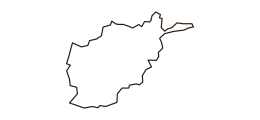
Afghanistan
South Asia
Asia
Afghanistan is a landlocked country located at the crossroads of Central and South Asia, with an estimated population of 43.8 million people in 2025. Life expectancy at birth is approximately 66 years, while the country's GDP was estimated at US$17.78 billion in 2024, with a GDP per capita of US$416.90. Afghanistan's Human Capital Index stands at 0.40, reflecting significant challenges in education, health, and productivity.
Afghanistan remains one of the world's least developed and heavily indebted poor countries, with decades of conflict, political instability, and economic fragility continuing to constrain development. Since the return of the de facto authorities in 2021, the country's civic space has deteriorated significantly. According to the CIVICUS Monitor (2024), Afghanistan is classified as "Closed," indicating the systematic erosion of fundamental freedoms. Civil society organisations, human rights defenders, journalists, and activists have little or no space to operate independently or safely. Reports document persistent harassment, arbitrary detention, torture, enforced disappearances, and severe restrictions on freedom of expression. Independent media outlets have been raided, closed, or subjected to extensive censorship.
The country has also attracted widespread international concern over the institutionalised discrimination against women and girls, with several international organisations and experts describing the current situation as "gender apartheid." These restrictions have severely limited women's access to education, employment, public life, and decision-making, further exacerbating Afghanistan's humanitarian and development challenges.
source of data: World Bank Data, CIVICUS Monitor.
HDI
0.496
PR
7
CL
7
ND-GAIN
32.76502