One of Geoformations’ core objectives is to communicate our research among diverse audiences within and beyond academia to encourage dialogue, invite feedback, and advance our contributions. This approach helps us to broaden the scope of our engagement and enhance the rigour and applicability of our research and the methodological approaches we apply.
In October 2025, two members of our team – PI, Dr Susan Murphy and Researcher, Maeve McGandy – travelled to Newcastle upon Tyne to participate in the BISA-ISA Joint Workshop on Decolonising Knowledge and Global (In)Justice: Exploring Research and Pedagogy in International Development Studies.
Across two immersive days of discussion, the workshop provided an invaluable opportunity to reflect methodologically on the early years of our Geoformations research, share practical and theoretical insights with peers, and exchange ideas with colleagues working across disciplines and geographies.
The work we shared in Newcastle emerged from our team’s ongoing, structured practice of individual and collective methodological reflection, which forms a central part of our research process. This work was subsequently developed and published as an academic article in the newly launched Turkish Journal of International Development (TUJID), entitled Assemblage Thinking and Methodological Reorientation in Development Studies (McGandy, Murphy & Paterson, 2025). This blog post introduces some of the central ideas explored in that piece.
Our Contribution
Development is often presented as a project of linear progress, a challenge to be solved through better policies, improved data, and stronger institutions. These assumptions in turn inform how development is governed, practiced, and studied. Our paper reflects on whether some of the conceptual and methodological lenses through which development is commonly understood are adequate for engaging with the complexity of the field.
Our research, grounded in assemblage thinking, prompts and proposes an alternative perspective on development, which is particularly useful for studying development governance. The assemblage ethos we adopt across our case studies approaches development as a constantly evolving web of relationships between actors, institutions, knowledges, and local lived realities. This is in contrast to prominent ideas of development as a fixed, top-down system of actors and entities operating at distinct scales, from the local to the global.
Drawing on insights from our multisited empirical research, zooming in specifically on our desk-based work and case studies in Ukraine and Costa Rica, we begin to explore how an assemblage-informed approach can illuminate development governance as a dynamic, relational field of practice that moves beyond conventional spatial and scalar boundaries, allowing us to better examine how it operates within and across contexts.
Rethinking Development Governance
We argue that the current moment in the field of international development cooperation presents an opportunity to rethink how development is studied and understood. As a continually evolving field, shaped both by abrupt geopolitical shifts and longer-term transformations in financing and institutional support, development demands methodological and analytical approaches capable of engaging with its complexity and dynamism.
Development governance is an inherently multi-scale endeavour. Agendas are often set internationally, take on national significance through domestic politics, and are implemented locally, where specific contexts influence practices and outcomes. However, these processes are rarely linear or as top-down as they are often conveyed.
In practice, decision-making processes rarely follow a clear, hierarchical trajectory. Instead, power relations, competing forms of knowledge, and contextual priorities continually orient (and reorient) development agendas. As a result, global frameworks are not simply implemented in local contexts. Something more complex happens, we argue, as development agendas, interventions, and practices are transformed through the contexts in which they operate.
These dynamics challenge conventional understandings of development as linear and somewhat predictable, inviting reflection on how it is studied. As such, they highlight the limitations of approaches that treat development as a straightforward process of transferring knowledge, resources, and authority from global to local contexts.
Towards an Assemblage Approach
Assemblage thinking offers an alternative way of approaching the study of development. Rather than treating governance as stable, unidirectional process, it understands it as dynamic and relational, emerging through interactions among global agendas and imperatives, national politics, local practices, and context-specific dynamics.
This perspective matters because it shifts analytical attention away from the implementation of policies and interventions towards the relationships through which development governance is assembled in practice. Assemblage thinking therefore encourages us to ask different questions:
- How do relationships between diverse actors influence development governance in practice?
- How do global agendas interact with national politics and local realities?
- How is development governance assembled through interactions within and across sites and scales?
Thinking Through Assemblage
Our paper presents assemblage thinking as an investigative ethos. Across our case studies, it provides a way of understanding development governance as an adaptable, evolving field of practice, particularly in times of rapid change. It foregrounds the fluid and contingent nature of development governance, illuminating how diverse actors, institutions, discourses, and practices interact and intersect to influence development in specific contexts.
A core premise of this approach is that the components of an assemblage retain a degree of autonomy while continually interacting with one another. Assemblages are therefore inherently fragile and open to change, with power distributed unevenly and agency emerging through relations rather than residing with any single actor, site, or entity.
Research informed by assemblage thinking requires tracing these evolving dynamics and relationships, rather than seeking to categorise or stabilise entities and the relations between them. It therefore requires researchers to embrace uncertainty and to remain open to exploring unexpected empirical trajectories. For us, assemblage is conceptualised as a process of “co-functioning,” in which heterogenous elements come together, interact, and continually transform one another.
This focus on change and continual evolution is central to why we are drawn to an assemblage approach. Deleuze and Guattari (1987) conceive of assemblages as never fixed. They always hold the potential for new formations, as relations between actors, institutions, discourses, and practices are continually reconfigured. This means that studying development through an assemblage lens requires a reflexive and responsive approach, one that is attuned to moments of disruption, adaptation, and transformation, and recognises these as opportunities for new ways of understanding development governance.
Our Research
Our Geoformations research applies this approach to explore how development governance is continually assembled and re-assembled across contexts. We focus on:
- Shifting actor networks
- Changing policy priorities
- Evolving flows of financing, knowledge, and decision-making
- Interactions within and across scales
To illustrate some of the methodological insights emerging from our research, we revisit two distinct methodological cases within our broader research project. Though distinct, together these cases productively illuminate development governance as an evolving and relational process, rather than a fixed system.
- Tracing localisation in development policy – here, we examined how institutional donors interpreted and operationalised localisation and locally led development within their policy positions
- Assemblage mapping in Ukraine and Costa Rica – here, we traced how networks of development governance emerged and evolved in practice
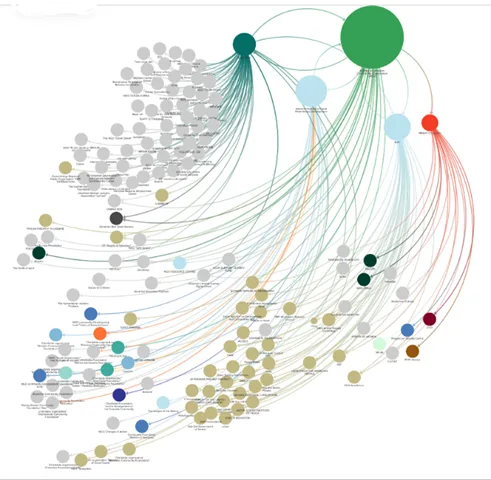
Fig 1: Development Governance Assemblage Map (Ukrainian Context) | Diagram created by C. Maswili Mwende and S. Murphy (2025) using Kumu.
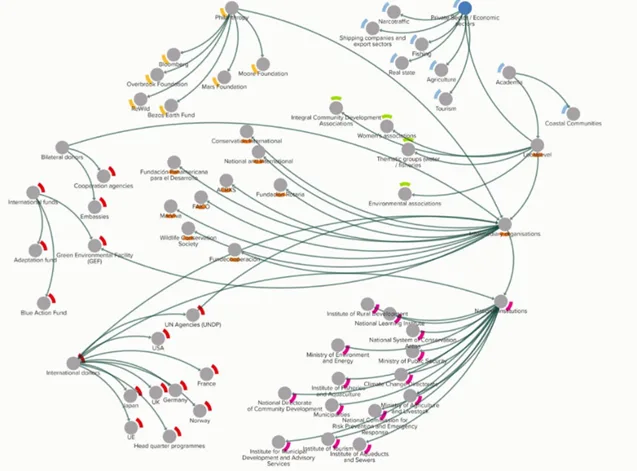
Fig 2: Development Governance Assemblage Map (Costa Rican Context) | Diagram created by C. Maswili Mwende and I. Lopez Arce (2025) using Kumu.
Four Insights from Our Research
These cases highlighted not only the contradictions within contemporary development governance, but also the methodological and analytical value of an assemblage approach. Beyond their empirical contributions, they enabled us to reflect on the value of assemblage thinking as a means of studying development governance. From this reflection, we identified four particularly valuable dimensions of this approach: deep contextualisation, an expanded scalar analytic, openness to uncertainty and ambiguity, and attentiveness to contingency and change.
(1) Reading Governance in Context
Assemblage thinking in development research requires close attention to how interventions and practices are embedded within specific historical, institutional, and discursive contexts. Our cases traced how discourses, such as localisation and locally led development, become institutionalised, and how meanings are constructed and reinterpreted across contexts. We also sought to examine how relationships between actors and institutions emerge and evolve in response to changing internal and external conditions. In practice, this meant situating localisation within longer-term aid reform cycles, while tracing how historical funding patterns shaped the governance assemblages mapped in Ukraine and Costa Rica.
Understanding current governance configurations requires placing them within the longer-term trajectories through which they emerge, which can help to more closely illuminate how and why development governance evolves over time. Although balancing depth and breadth is challenging careful contextual analysis reveals dynamics that might otherwise be overlooked. While this approach is time- and labour-intensive, engaging such complexity is essential for nuanced understanding.
(2) The Expansive Potential of Scalar Analysis
Assemblage thinking challenges the idea that geographical scale is fixed or hierarchical, emphasising the processes and interactions that bring different sites and nodes of governance into relation. In our localisation study, we analysed the policies and ODA flows of thirty-two donors, revealing considerable diversity in their discourses, commitments, and practices. This demonstrated that donors – as a category of analysis or a governance “scale” – are far from monolithic. This distinction is particularly important for development governance, where scalar categorisation often obscures its dynamic character, the diversity of actors involved, and the fluid nature of both power and agency.
In Costa Rica and Ukraine, mapping governance assemblages allowed us to move beyond the usual ‘global vs local’ dichotomy that pervades development studies by recognising actors – and the sites and scales at which they operate – as relational and co-constituted.
For example, Costa Rican CSOs simultaneously report acting as recipients, intermediaries, and agenda setters, while organisations we engaged with in Ukraine serve as both local implementation partners and more regional nodes in terms of governance. Assemblage mapping allows such contextual factors to inform analysis, acknowledging the inherent spatial and scalar heterogeneity of development practice.
Our openness to an expanded scalar analytic allowed us to analyse how development governance is assembled across multiple interconnected scales, conditioned by the interaction of diverse historical, geographical, institutional, and discursive contexts. This required diverse datasets and an openness to methodological and analytical pluralism. Our treatment of scale as relational and contingent aligns with critical development studies’ commitment to challenging hierarchical power relations by viewing scales and governance configurations as contested and continually (re)produced.
(3) Uncertainty is Inherent
Assemblage thinking does not require consensus to produce meaningful analysis. This was particularly evident in our research on localisation, where competing interpretations of the concept – both within and across donor contexts – were shown to underpin policy and governance. By attending to how ideas and concepts are variously framed, operationalised, and contested, our approach aligns more closely with relational and poststructuralist perspectives than with positivist approaches oriented towards singular explanation.
As for the practical relevance of this insight, our work to date has repeatedly illuminated significant gaps between rhetoric and practice in the context of development governance. This produces tensions, especially for a field of practice in which practitioners often strive towards consensus. Assemblage research, however, does not treat indeterminacy or inconsistency as problems to be resolved. Such dynamics productively demonstrate how power operates in context, often through ambiguity. Mapping multiple and oftentimes conflicting accounts of how development is governed, as was the case in Ukraine and Costa Rica, exposes certain silences and omissions, and further underscores the contested and contingent nature of development governance.
(4) Change is Constant
Finally, an assemblage approach highlights and engages with the fluid, ever-changing nature of development governance in practice, which has been a central feature of our work to date. Networks of cooperation and collaboration in Ukraine and Costa Rica shifted constantly through the entry and withdrawal of entities, against a backdrop of evolving funding flows and ever-changing institutional ties. The dismantling of USAID in early 2025, for instance, dramatically reshaped the donor landscape, illustrating how systems of support can rapidly unravel and be reconfigured.
Our reflexive approach has allowed us to capture many such moments of flux, and to remain open to iterative re-evaluation as relations evolve. This aligns with broader approaches in human geography and development studies that focus on the temporal and spatial fluidity of governance arrangements. Contingency and change are central to how governance operates; they are not anomalies. Our approach seeks to acknowledge this from the outset and to remain attentive to it throughout the research process.
To Conclude
These four insights highlight the value of an assemblage lens for studying development governance, drawing on the empirical and methodological lessons gleaned from our research to date. We argue that assemblage thinking extends critical development studies by moving beyond fixed scales, entry points, and units of analysis towards more relational and context-sensitive ways of studying development. Less a ‘blueprint’ for research, assemblage thinking offers a fundamentally curious and expansive investigative ethos that embraces and engages complexity, heterogeneity, and change.
Applying an assemblage-informed methodology is not, of course, without its challenges. It can be resource- and time-intensive, methodologically demanding, and insights do not always translate easily into straightforward recommendations for policy and practice. Beyond that, it requires researchers to remain reflexive about their own position within the systems they study. Such challenges, however, do not diminish the value of assemblage thinking. They simply reflect the inherent complexity and contingency of development governance and reinforce the need for analyses sensitive to context, relationships, and change.
Assemblage thinking is not a panacea. It does, however, enrich development studies by encouraging diverse ways of knowing, situating analysis in context, and engaging with geographical scale as relational rather than fixed. Methodologically, it offers a framework for navigating uncertainty, and for tracing change as it occurs. In a rapidly changing world, this sensibility offers a way to better understand the complexities of the lived realities of governance – in place, and over time.