This blog forms Part 1 of a two-part series reflecting on field research undertaken in Costa Rica’s Pacific Region.
When tropical storm Sara hit the Pacific region of Costa Rica, infrastructure was damaged, roads were blocked, houses and businesses were flooded, and lives were disrupted for weeks. While the country’s central valley tends to receive more political and economic attention, coastal communities are left with fewer resources to prepare for and respond to extreme weather events like this. In the immediate aftermath, it is largely community-based organisations that step in and take the lead. They coordinate emergency response efforts and, just as importantly, work to strengthen long-term resilience in the face of accelerating climate change.
These relief and recovery efforts do not emerge or proceed in isolation. Rather, they are embedded within and realised through a complex web of relationships among communities, local organisations, larger non-governmental organisations (NGOs), academia, public authorities, and donors.
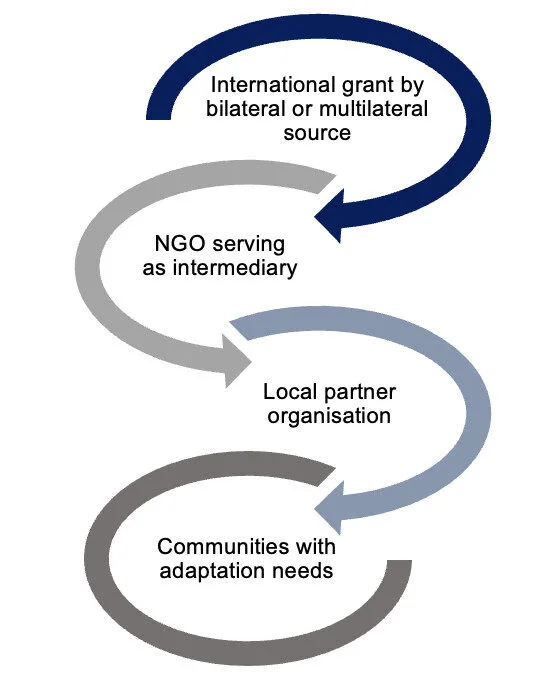
Adaptation finance – the funding dedicated to helping societies respond and adjust to climate change – flows through multiple bilateral and multilateral channels, with bilateral Overseas Development Assistance (ODA) remaining the dominant source. In places like Costa Rica’s Pacific coast, these funds typically reach communities through partnerships with NGOs, who play a crucial role in translating global finance into local action (see Figure 1 below).
Geographical Context: Costa Rica’s Pacific Region
Costa Rica joined the OECD in 2021, yet some areas of development remain highly dependent on international aid, including climate adaptation. The country is located in Central America, one of the world’s regions most exposed to extreme weather events, where climate change is already exacerbating socioeconomic vulnerabilities.
The country’s Pacific coastal region has particular ecological and geopolitical significance, both nationally and internationally. This region forms part of the Eastern Tropical Pacific Ocean, one of the world’s most biodiverse marine areas, which provides ecosystem services including food security, tourism and carbon storage. At the same time, it serves as a route for transnational organised crime and illegal, unreported and unregulated fishing.
The convergence of climate vulnerabilities, social inequalities, ecological importance, and security challenges within and across the region has drawn significant attention from international donors and NGOs engaging in adaptation finance.
Given the region’s climate vulnerability, the central role NGOs play in leading responses, and the high degree of dependency on international funding, we at Geoformations wanted to understand how these factors intersect to both enable and constrain practice within the adaptation-development nexus. Our case study explores how shifting international funding conditions are shaping the way NGOs work and collaborate in climate adaptation. In this blog, we focus on the first part of that research – examining how key actors, institutions, policy frameworks, and narratives interact to shape climate action on the ground.
NGOs at the Frontline of Adaptation
Our study highlights the crucial role that NGOs play in driving climate adaptation efforts in Costa Rica’s Pacific coastal region. These organisations are often the ones translating plans into action, even as they face limited opportunities or spaces for collaboration and a heavy reliance on external funding. In recent years, this work has become even more challenging as the scope for national-level coordination and partnerships has been constrained, leaving NGOs to navigate increasingly fragmented systems.
Policy frameworks in Costa Rica recognise the central role of NGOs in climate adaptation. The National Adaptation Plan, for example, assigns primary responsibility to state institutions but identifies NGOs as key partners in the implementation of every adaptation goal.
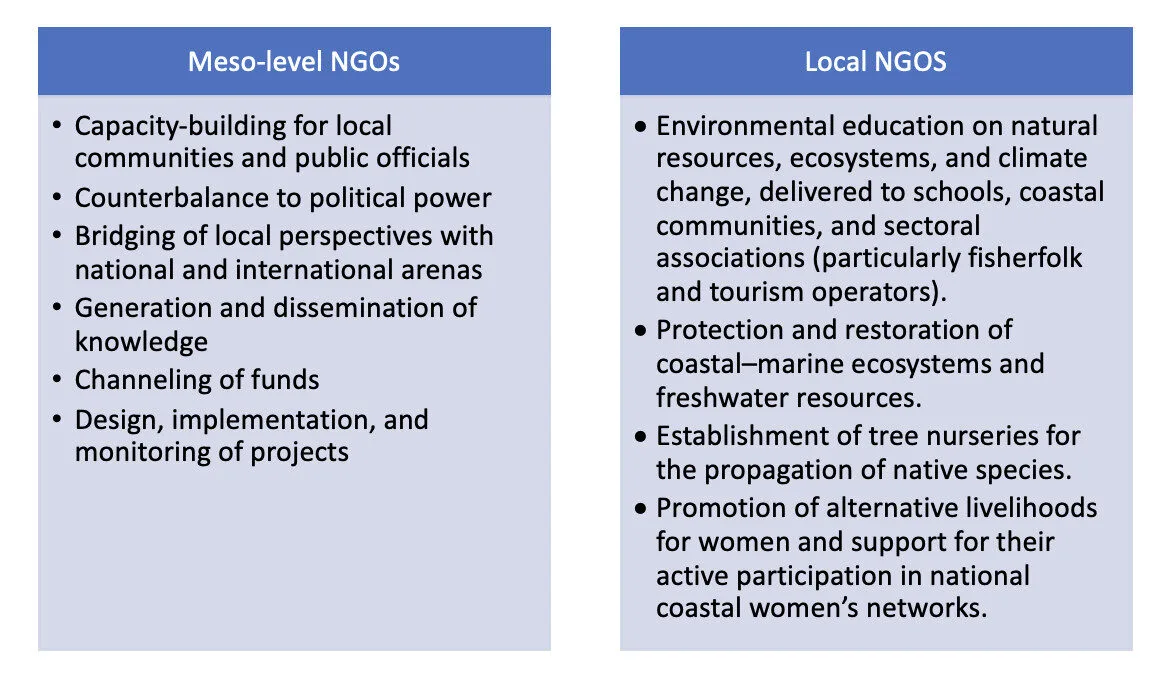
NGOs also play a pivotal role in connecting different levels of action and information. At the local level, every grassroots organisation we spoke with runs climate change awareness programmes, and advocates for community priorities with intermediaries and donors. Meanwhile, regional or meso-level organisations translate donor agendas and share technical knowledge with both governments and communities. See Figure 2, below, for some of the distinct activities reported by NGOs we spoke with.
Of course, NGOs are far from a uniform group. They vary widely in terms of resources, capacities, focus areas, sites and scales of operation, and influence. Understanding how climate adaptation is governed means recognising these differences, between – for instance – large professionalised transnational NGOs and smaller grassroots groups, and paying attention to the multi-level spaces in which they operate. These spaces shape how organisations interact with one another, with donors, and within the wider governance landscape.
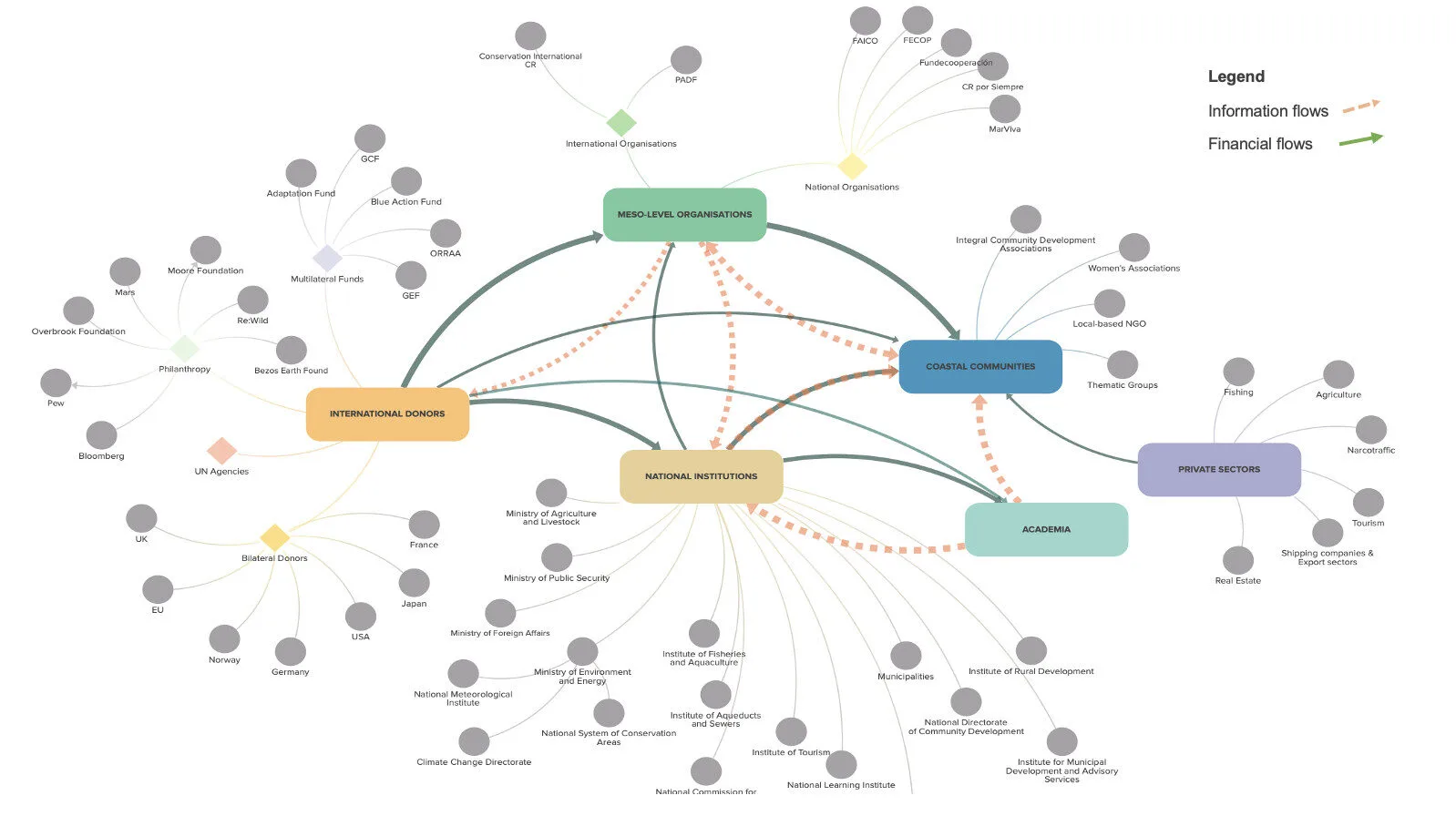
In our research, we think about this landscape as an assemblage: a dynamic space where diverse actors and interests converge, interact, and sometimes compete, while collectively contributing to advancing climate adaptation efforts. Figure 2 below offers a visual sketch of this assemblage as we observed it during the early stage of our field research.
Donor-NGO Dynamics
The level of decision-making power NGOs hold in project design often depends on the donor or programme involved. Some organisations described having meaningful opportunities to negotiate and shape project priorities and co-design initiatives with communities, supporting locally led and context specific adaptation efforts.
However, donors sometimes arrive with pre-conceived ideas, pre-set agendas, unrealistic expectations, and limited understanding of local realities. This has become increasingly common, particularly as overall international funding declines. Such dynamics can strain donor–NGO relationships, prompting many organisations to diversify their funding sources.
Despite these power imbalances, many NGOs still see greater advantages in working with international partners than with national institutions. For local organisations, this often reflects a lack of trust in public systems that they feel have neglected their needs and failed to provide the technical capacity required to tackle local challenges.
Reported benefits of working with international funders include a stronger sense of community ownership over projects, as this approach helps reduce the risk of government actors politicising local initiatives and activities. For local organisations that have developed sufficient capacity to access bilateral funds directly, it also offers a faster and more flexible route to implementation compared to working with and through state institutions.
At the same time, donor engagement in the region is not neutral. Funding flows often reflect broader geopolitical and geoeconomic interests. The Pacific holds strategic geographical importance, and donor countries frequently use grants to protect and advance their own interests and priorities. A clear example is the United States’ Central American Regional Security Initiative (CARSI), which has become one of the main donors for climate adaptation in the area.
The Politics of Climate Financing
Costa Rica has long benefited from its reputation for good governance and political commitment to climate action, qualities that have helped attract adaption financing. Under the Chaves Robles administration (2022-2026), however, weakened inter-institutional coordination, reduced international engagement, and growing tensions between the state and civil society are putting that reputation at risk. These shifts could ultimately affect the ability of organisations to secure the international support needed for effective climate action.
Costa Rican environmental organisations are increasingly vulnerable amid signs of democratic backsliding. Some NGOs have already scaled back their advocacy efforts to safeguard their operational space – a worrying development in a country where civic activism has historically been the backbone of environmental progress.
Aid Dependence
Costa Rica’s long-standing status as a preferred recipient of international cooperation for climate action has fostered a dependence on external funding, both within government institutions and across NGOs. Accession to the OECD raised expectations that aid would gradually decline, but national actors were unprepared for how rapidly funding levels would shrink. Recent shifts in conditions of international aid have only rendered this dependence more visible.
It is important to recognise that this reliance is not solely the responsibility of local actors. The climate finance system itself is structured in ways that perpetuate dependency, with donors retaining decision-making power at multiple levels: from international funding commitments to country-level allocations, programme design, and reporting requirements.
Now, as changes in international development funding intersect with Costa Rica’s own institutional and financial constraints, NGOs along the Pacific coast find themselves in an increasingly difficult situation. Our next blog will explore how these shifting conditions are impacting these organisations and shaping both their work and their resilience.
Looking Ahead
Our Costa Rican case study reveals both the strengths and the fragilities of the governance system shaping climate adaptation along the Pacific coast of Costa Rica. NGOs remain at the heart of these efforts, but their dependence on international cooperation – influenced by donor agendas and domestic politics – leaves them deeply exposed to shifting global dynamics.
As international aid flows continue to evolve, the ability of these organisations to adapt will be central to the resilience of coastal communities. What’s at stake is the credibility of climate adaptation as a genuinely locally driven and sustainable process.
In our next blog, we’ll explore how NGOs in the region are navigating these changing conditions and the strategies they are using to sustain their work in an increasingly uncertain funding landscape.
Note: This blog post draws on reflections from ongoing research that will be further developed in forthcoming academic publications.

Author Profile: Ivonne López Arce is a Research Assistant on the Geoformations team. Ivonne recently completed an MSc in Development Practice at Trinity College Dublin. Her professional trajectory spans policy analysis at the International Institute for Sustainable Development and climate diplomacy at the UK’s Foreign, Commonwealth and Development Office, engaging with governments in Latin America and the Caribbean. She has also collaborated with youth and indigenous groups across Latin America and Southeast Asia. Ivonne currently serves on the Expert Advisory Panel of the Earthshot Prize, evaluating innovative environmental solutions from around the world. Her current research explores the implications of aid budget contractions on local organisations and the evolving assemblage of adaptation-development cooperation in coastal Central America, analysing how communities navigate, negotiate, and reconfigure resilience within the current geopolitical conjuncture.
