
This blog forms Part 2 of a two-part series reflecting on field research undertaken in Costa Rica’s Pacific Region.
At Geoformations, our work in Costa Rica’s Pacific Region offered a case study for understanding how shifting funding conditions, across scales, influence the governance space in which NGOs engaged in climate-adaptation operate.
The first instalment in this blog series traced adaptation aid in the region through an assemblage lens, highlighting how the field is influenced by donor-NGO relations, climate politics, and scalar developmental dynamics. In this blog, we focus specifically on how shifting funding conditions are affecting NGOs in the region, and how organisations are navigating the changes.
Though 2025 has brought with it profound changes to the aid system globally, the patterns observed and discussed below may appear familiar to those who have experienced or studied aid downturns in the past. The current conjuncture is marked by top-down decision-making, weak – or in many instances absent communication, and an absence of robust exit strategies. However, behind these structural issues lie the very real impacts on projects, staff, and the coastal communities they serve
The Dissolution of USAID and Subsequent Cuts:
Although USAID did not maintain a physical office in Costa Rica, many national NGOs received funding through international intermediaries. When aid was abruptly cut, some NGOs reportedly lost up to 70% of their annual budgets virtually overnight. Initiatives supported through the Central America Regional Security Initiative (CARSI) – a key funding stream for organisations working in the Pacific – were also affected. The immediate consequences of the Trump administration’s decisions included project suspensions, staff dismissals, and deepening long-term uncertainty.
By early 2025, several adaptation initiatives and activities had been suspended or cancelled, including:
- Women-focused coastal management and fisheries projects
- Efforts to protect water sources and strengthen water security
- Organisation of regional, sectoral and multilateral summits
- Participatory decision-making processes with and within communities
- Development of financial mechanisms to support local adaptation initiatives
- Capacity-building for communities and public officials focused on the sustainable use of natural resources
- Support for policy development and reform processes
Language Politics:
Language plays a significant role in shaping development project narratives. For NGOs in Costa Rica’s Pacific region, the pressure to survive in a shrinking aid landscape requires adjusting the language used in practice, especially within funding proposals, to align with donor priorities, particularly those of US based agencies and foundations.
Projects once centered on climate risk reduction had to be reoriented towards reducing migration. Initiatives designed to include women in fisheries governance – a sector traditionally dominated by men – have been reframed as efforts to stop coastal communities from engaging in illicit activities. Even the vocabulary has shifted: “climate change” becomes “atmospheric change,” “sustainable development” is shortened to development, and terms like “gender” disappeared altogether.
US foundations are following similar linguistic trends, leaving NGOs with fewer options if they resist adapting their language. Indeed, half of the intermediate organisations that participated in our study reported to have removed words like “climate” and “gender” from their websites, even though other donors still require those very terms.
In Costa Rica, more established organisations are making considerable strategic efforts to reshape and (re)formulate projects in line with donor interests while still safeguarding their core objectives. NGOs with more limited capacity, however, struggle to adapt as quickly to new and emerging thematic framings, leaving them increasingly vulnerable in a highly competitive funding landscape.
This shift in project narratives is not merely rhetorical. It also requires organisations to adjust their operations to accommodate new types of activities, and it also affects partnerships and relationships. Communities can experience repercussions when NGOs and donors amend previously agreed projects, especially when new “adaptation” activities risk overlooking locally perceived priorities.
Funding Diversification
Reduced funding flows and increased competition have forced organisations to diversify their income streams. Our research identified six main strategies applied in doing so:
- Seeking funds from new geographic regions
- Diversifying economic activities
- Exploring new thematic areas
- Turning to philanthropy
- Getting accreditation to access international funds
- Exploring unconventional approaches, from inviting donors onto their Executive Boards in exchange for unrestricted funds, to looking for direct donations from tourists visiting the Pacific Coast
Yet diversification is not straightforward in practice. In many cases, NGOs lack formal fundraising strategies or dedicated fundraising staff, leaving teams overstretched in a context of limited resources and fierce competition.
Jobs on the Line
Funding cuts are not just about projects or activities; they also have a direct impact on the people working in the sector. They impact people’s livelihoods.
Even before recent aid cuts, job security and fair remuneration were persistent challenges in the region. Public donors, in particular, often cap salary costs, making it hard for NGOs in Costa Rica – an expensive country with strong labour laws – to remain competitive in international bidding processes. The result is that meso-level NGOs depend heavily on short-term in-country consultants to carry out their projects, while local organisations are forced to rely on volunteers. These conditions gravely threaten staff retention and the improvement of social conditions on the coast.
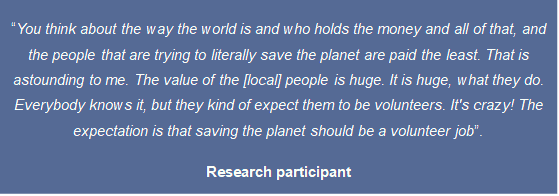
As budgets shrink, organisations are laying off staff and suspending contracts. Even participants in our research voiced concerns about their own job security. It is a difficult paradox: organisations must reduce their workforce at the very moment they require greater capacity to adapt to new conditions.
Implications for Climate Justice
The power dynamics that underlie shifting aid conditions are directly affecting and marginalising communities that should be at the centre of adaptation governance.
Adaptation aid remains a matter of climate justice, particularly in the current development landscape. The power dynamics that underlie shifting aid conditions are directly affecting and marginalising communities that should be at the centre of adaptation governance. Coastal populations will continue to bear the greatest impacts and burdens if the consequences of aid cuts are not addressed. This is evident in the fact that the projects eliminated thus far were those designed to target the needs of the most vulnerable groups, including women, artisanal fishers, and people facing water insecurity.
While immensely challenging, these periods of uncertainty also represent an opportunity for a broader paradigm shift in adaptation governance, as highlighted by many of the organisations that participated in our study. They point to the need for long-overdue reforms in how adaptation finance is channelled, delivered, and implemented in Costa Rica, reforms that promote less dependency and more effective, just and locally led approaches.
Towards Locally Led Adaptation
Costa Rica’s experience reflects a wider global trend. As donor priorities shift and budgets shrink, the future of climate adaptation depends increasingly on local agency: the ability of communities and NGOs to define, lead, and sustain their own strategies.
Understanding how these shifts unfold in practice, as we have observed in Costa Rica’s Pacific region, is crucial for reimagining adaptation governance across the Global South.
Note: This blog post draws on reflections from ongoing research that will be further developed in forthcoming academic publications.